

Bridge Program
Transferring into the
AlcheMē Yoga Therapist Training.
You did the work. You have the certificate. You shouldn't have to start over to become a yoga therapist.
You completed a 300-hour training somewhere other than Be The Change, and now you want to go further, toward the kind of practice where someone walks in with a real condition and you know what to offer them. The bridge is how you join our IAYT-accredited 825-hour AlcheMē Yoga Therapist Training without repeating a year of coursework you've already done.
Trainings taken elsewhere rarely transfer in full, and we'd rather you hear that from us now. Hours have to align with yoga therapy competencies and be taught by credentialed yoga therapists. Most 300-hour programs, however good, were built to make you a better teacher. That's a worthy thing, and a different purpose.
So we do two things. We look carefully at everything you've already done and credit all of it that fits. Then we ask you to complete three core courses and sequencing coursework: the framework the rest of the training is built on.
How much transfers
Yoga Alliance registered 300-hour
Up to 200 hours
IAYT-accredited yoga therapy program
Up to 300 hours
Your 200-hour training is what qualifies you to apply. Those are prerequisite hours and never transfer. Neither do electives, partial credit for incomplete yoga therapy courses, or any hour we can't verify against a certified transcript and a syllabus.
The bridge emphasizes
Yoga therapy as lifestyle medicine: Ayurveda, public health and root-cause care
The Yoga Sutras as a practical framework for working with clients
The therapeutic relationship: holding a professional container, trust and boundaries
Safe, intelligent, adaptive sequencing for real bodies and real conditions
A note on your credential
If your 300-hour training was with a Yoga Alliance registered school, you're already eligible to register as an RYT500. The bridge doesn't give you that, because you already have it. What it gives you is entry into an IAYT-accredited yoga therapist training.


The Syllabus
Three core courses, plus sequencing.
Every transferring student takes the three core courses. Your sequencing track decides how much sequencing you add. The bridge runs October 2026 through September 2027, and every session is recorded, so a busy month never puts you behind.
Lifestyle Medicine: Yoga Therapy, Ayurveda + Public Health
Katie Allen · Zoom · Tuesdays, 12:00–1:30 PM PT · 25 hrs
Yoga therapy is lifestyle medicine. This year-long course places the yogic tradition beside modern public health: Ayurveda as preventative care, root cause over symptom, and where yoga therapy fits in the wider landscape of healthcare.
Session 1
October 20, 2026
Session 2
November 17, 2026
Session 3
December 15, 2026
Session 4
January 19, 2027
Session 5
February 23, 2027
Session 6
March 16, 2027
Session 7
April 13, 2027
Session 8
May 11, 2027
Session 9
June 15, 2027
Session 10
July 20, 2027
Session 11
August 17, 2027
Session 12
September 14, 2027
The Yoga Sutras for Yoga Therapy
Katie Allen · Tea House or Zoom · Wednesdays, 11:00 AM–12:15 PM PT · 22 hrs
The Sutras as a practical guide rather than a philosophy text. Four chapters across twelve months, rooted in the lineage of T. Krishnamacharya, translated into yoga therapy practices for your clients.
Chapter 1 · Part 1
October 21, 2026
Chapter 1 · Part 2
November 18, 2026
Chapter 1 · Part 3
December 16, 2026
Chapter 1 · Part 4
January 20, 2027
Chapter 2 · Part 1
February 24, 2027
Chapter 2 · Part 2
March 17, 2027
Chapter 2 · Part 3
April 14, 2027
Chapter 2 · Part 4
May 12, 2027
Chapter 3 · Part 1
June 16, 2027
Chapter 3 · Part 2
July 21, 2027
Chapter 3 · Part 3
August 18, 2027
Chapter 4
September 15, 2027
Basic Principles of the Therapeutic Relationship
Recorded course + workbook · Two parts, March and April 2027 · 9 hrs
How to hold a therapeutic relationship rather than teach a class. It covers IAYT competency 3.2, which a 300-hour teacher training almost never addresses. It's the single largest predictable gap between a teaching qualification and a therapy qualification, so we ask everyone to take it.
The Sequencing Series
Allison Prince · Studio, Zoom or recording · Fri 4:30–7:30 PM + Sat 12:30–5:30 PM PT · 8 hrs each
Therapeutic sequencing using vinyasa krama: assessment-led practice design, adapting for real bodies and real conditions, and the why behind every sequence you teach. You design and teach sequences yourself and get direct feedback.
Weekend 1 · A + B
November 6–7, 2026
Principles of Safe Sequencing
Weekend 2 · Track B
December 4–5, 2026
Sequencing Through the Panchamaya Model
Weekend 3 · Track B
January 8–9, 2027
Sequencing Through the Pranavayu Model
Weekend 4 · Track B
March 5–6, 2027
Teaching Beginners
Weekend 5 · Track B
April 2–3, 2027
Sequencing for Therapeutic Classes + Using Props
Your sequencing track
Everyone takes Principles of Safe Sequencing. It's where we set a shared standard for teaching safely. Whether you take the other four weekends depends on the optional teaching assessment with Allison.
Track A · Assessed, placed out · 64 hrs
Your assessment showed the therapeutic sequencing foundation Allison is looking for. You take the November weekend only.
Track B · Full series · 96 hrs
You take all five weekends, either because your assessment placed you here or because you chose not to be assessed. Same coursework, same price.
Track B isn't a failure, and we won't treat it as one. Volume isn't the same as therapeutic teaching: you can teach ten classes a week and never once adapt a practice for someone with a disc injury. The only honest way to know is to watch you teach, and the series is good coursework in its own right.
How it works
Apply. The 825-hour application asks about your training, your teaching, and how confident you feel in front of a room.
Send your transfer credit request. A short form and a course-by-course spreadsheet, with your certified transcript, both certificates, your 300-hour syllabus, and instructor credentials where you have them.
A program director reviews your transcript against the IAYT competency categories. Plan on three to four weeks once your file is complete.
Take the teaching assessment, if you choose. You send Allison a sequence, then teach it to her live. It's the only way to place out of the full series.
Receive your written determination: hours accepted by category, your total, your track, and why.
Enroll. Registration fee and autopay, set once. There's never a second charge to add coursework later.
Enroll in the bridge
One price list, set once.
Pay in full, or pay the registration fee as your first payment and the rest by monthly autopay. The registration fee is part of your total, not on top of it.
Track A · Assessed
$1,255
$100 assessment, paid separately
$450 registration + $235 × 3 months
Track B · Assessed
$1,555
$100 assessment, paid separately
$350 registration + $221 × 5 months
Track B · Not assessed
$1,555
No assessment fee
$450 registration + $221 × 5 months
You only pay for the assessment if it saves you money. If it places you in Track A, the $100 is part of your $1,255. If it places you in Track B, it's credited: your registration drops to $350 and your total is the same $1,555 as someone who was never assessed. The assessment is booked after your transcript review and isn't refundable once the session has taken place.
Not included
Course #2 tuition
Books and resources
Additional coursework a program director prescribes for a gap the bridge doesn't cover ($175 per weekend intensive)
Faculty mentorship ($55/hour) and independent study
A studio membership. You're welcome in our classes while you study with us, at 50% off any class pack.
After the bridge
You finish the bridge in September 2027 and join the cohort for Course #2 (Musculoskeletal) in October 2027, then continue through Courses #3 and #4 and the clinical practicum.
Transfer credit applies only to Course #1. Every student completes Courses #2 through #4 and the full practicum here. That's what the C-IAYT credential requires.
The bridge is for teachers who completed a 300-hour training elsewhere. If you're weighing whether to transfer or start fresh with our full 300-hour, that's a conversation worth having out loud. Write to Katie at katie@bethechangeyoga.com.
Your Teachers
Katie Allen.
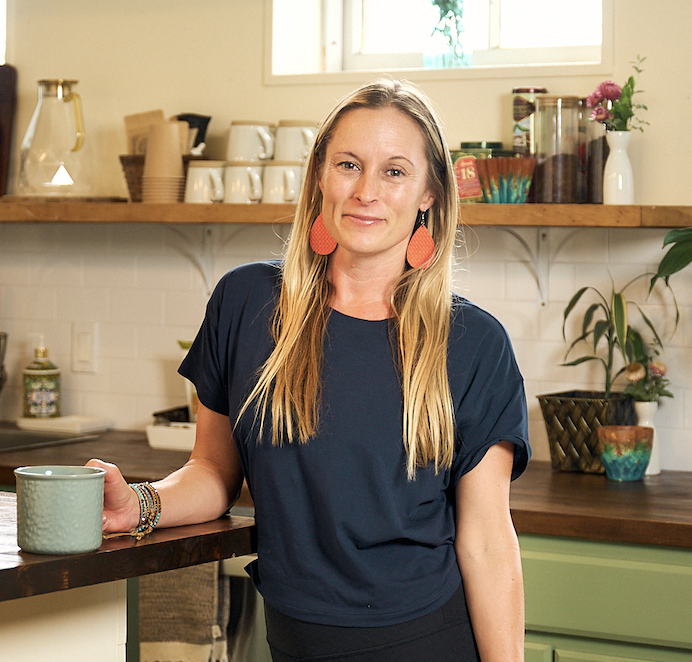
MPH, C-IAYT, AWC, E-RYT 500 · Lifestyle Medicine + Yoga Sutras
Katie is a public health researcher and integrative health program director with more than twenty years of experience building community-based yoga therapy and lifestyle medicine programs. She co-founded Be The Change Yoga, founded Orange County's first Yoga Therapist Training program, and serves as Founding School Director of the IAYT-accredited AlcheMē Yoga Therapy training.
She earned her Master of Public Health from Tulane University, completed her yoga therapy training in 2007 at Loyola Marymount University under Dr. Larry Payne, went on to study at the Krishnamacharya Yoga Mandiram in Chennai, India, and has been a Certified Yoga Therapist since 2009.
Allison Martin Prince.

MS, C-IAYT, E-RYT 500, CMT · The Sequencing Series
Allison co-founded Be The Change Yoga and serves as School Director of our 200-Hour Yoga Teacher Training Program. She has been teaching for more than twenty years and has led over 14,000 hours of group yoga therapy instruction.
She received her yoga therapist training through AlcheMē Yoga Therapy and holds a Master of Science in Human Nutrition and Functional Medicine. Her teaching weaves the subtle body practices (mantra, mudra and meditation kriya) into intelligent, anatomically grounded sequencing.